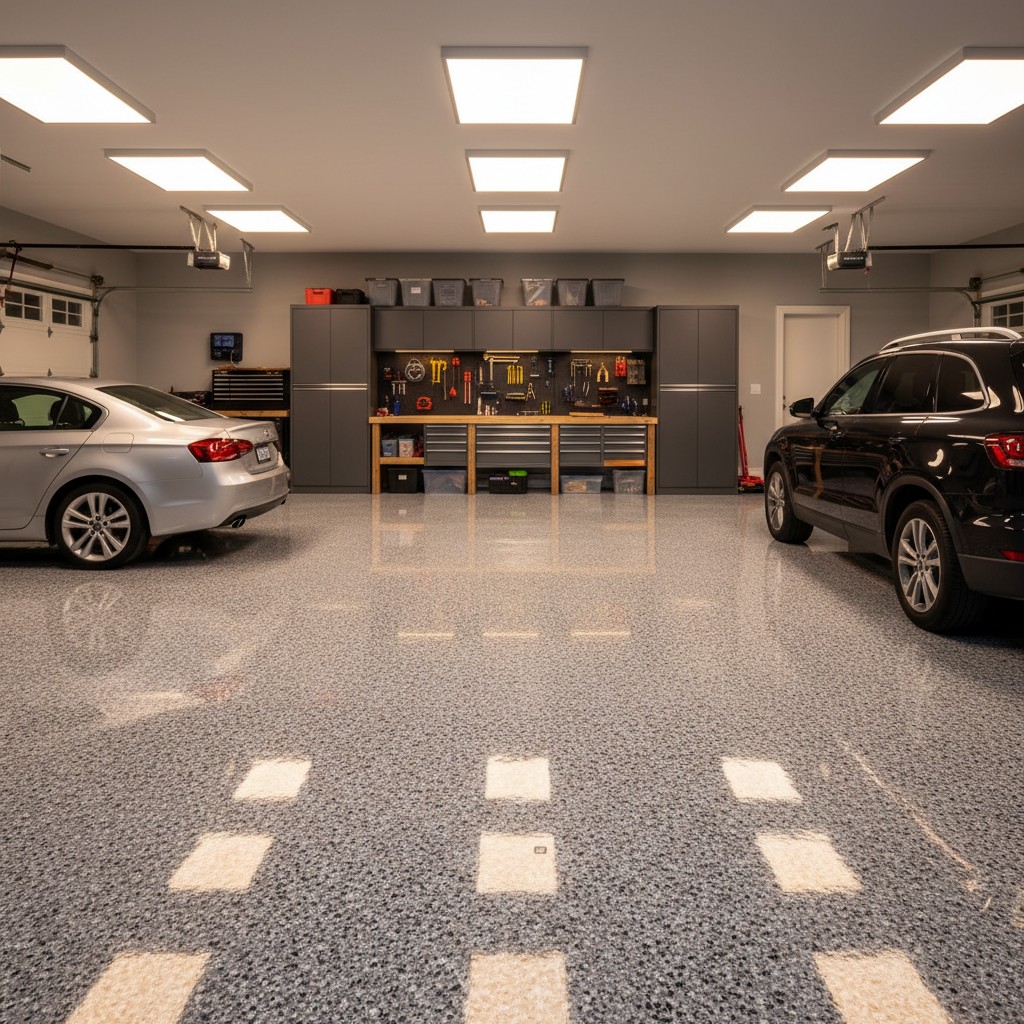
Epoxy Floor Coverage & Cost Calculator
Enter your garage dimensions, pick your coating system, and get instant material quantities with cost estimates. Then follow our step-by-step garage floor epoxy guides from prep to cure.
Garage Size
Coating System
Not sure which type? Compare epoxy vs polyurea or see our best kits guide.
Most water-based epoxies need 2 coats. Polycuramine and polyaspartic are usually 1-coat systems. How many coats do you need?
Recommended for smooth concrete, previously coated floors, or if using 100% solids epoxy. Improves adhesion and blocks moisture.
Adds UV protection, chemical resistance, and prevents hot tire pickup. Highly recommended for garages with vehicles.
Decorative Flake
Vinyl chips broadcast onto wet coating for texture and grip. Medium is the most popular choice. See color options and coverage rates
Floor Condition
Rough or damaged floors absorb more coating. The waste % is added to material quantities automatically.
Acid etch is cheaper ($25-50 in materials). Grinding gives better results but costs more: diamond discs ($25-60) are the main expense, plus grinder rental ($50-100/day). Full comparison
Materials Needed
Cost Comparison
| Line Item | Budget | Mid-Range | Premium |
|---|---|---|---|
| Coating (4 gal) | $180 | $260 | $360 |
| Clear Coat (2 gal) | $100 | $130 | $180 |
| Decorative Flake (16 lbs) | $56 | $72 | $96 |
| Prep Materials | $58 | $74 | $90 |
| DIY Total | $394 | $536 | $726 |
| Professional Estimate | $2,000 – $2,800 | ||
Recommended Products for This Coating Type
1-car garage kit, 2-part water-based epoxy. Best for first-timers.
View on Amazon →Polycuramine, 500 sq ft coverage. 20x stronger than water-based epoxy.
View on Amazon →3-coat system (primer + base + top coat). Professional-grade results.
View on Amazon →Product links may earn a small commission at no cost to you. Recommendations are based on coverage data and value, not commission rates. See full product reviews
Estimates based on manufacturer coverage rates. Actual coverage varies by surface porosity, application thickness, and technique.
Prices reflect national averages as of 2026. Your local pricing may differ.
Estimates only — always buy 10% extra to account for spills and touch-ups.
Need Help Deciding?
New to epoxy floors? These guides explain every option in the calculator above.
Compare water-based epoxy, polycuramine, 100% solids, and polyaspartic side by side.
Step-by-step instructions for cleaning, degreasing, moisture testing, and surface profiling.
Which prep method is right for your floor? Cost, safety, and effectiveness compared.
DIY vs professional pricing by garage size, including hidden costs most guides miss.
Rust-Oleum, RockSolid, ArmorPoxy, and polyaspartic kits ranked by value and performance.
Three ways to test your garage floor for moisture before coating — the #1 cause of failure.
How This Calculator Works
Uses manufacturer-published coverage rates to estimate epoxy coating, primer, clear coat, decorative flake, and prep materials. Coverage varies by product type: water-based epoxy covers ~250 sq ft/gal, polycuramine ~400 sq ft/gal, while 100% solids covers ~130 sq ft/gal due to thicker film build.
Waste factors are added based on floor condition (5-20% extra). Cost estimates reflect 2026 national averages across budget, mid-range, and premium product tiers.
Popular Guides
- How to Prep Your Garage Floor for Epoxy
The most important step in any coating project.
- Garage Floor Epoxy Cost Guide
Full breakdown of DIY vs professional pricing.
- Best Garage Floor Epoxy Kits
Honest comparison of top products for every budget.
- Epoxy vs Polyurea Comparison
Which coating chemistry is right for your garage?
- Is an Epoxy Garage Floor Worth It?
Pros, cons, cost per year, and the alternatives.
- Epoxy Cure Time: When Can You Park?
Dry, walk-on, and drive-on times by coating type.
Epoxy Needed by Garage Size: Quick Reference
Not sure where to start? These are the typical quantities for a two-coat system with a 10% waste factor, before adding primer, clear coat, or flake. Use the calculator above to adjust for your exact dimensions, coating type, and floor condition.
| Garage Size | Area | Water-Based (250 sq ft/gal) | Polycuramine (400 sq ft/gal) | 100% Solids (130 sq ft/gal) | Typical DIY Cost |
|---|---|---|---|---|---|
| 1-Car (12 × 20 ft) | 240 sq ft | 2–3 gal | 1–2 gal | 4–5 gal | $100–600 |
| 2-Car (20 × 20 ft) | 400 sq ft | 3–4 gal | 2–3 gal | 6–7 gal | $150–900 |
| 2-Car Deep (20 × 24 ft) | 480 sq ft | 4–5 gal | 2–3 gal | 7–9 gal | $200–1,050 |
| 3-Car (30 × 20 ft) | 600 sq ft | 5–6 gal | 3–4 gal | 9–11 gal | $250–1,300 |
For the reasoning behind these numbers, read how much epoxy you need for a garage floor. For a full pricing breakdown including professional installation, see the garage floor epoxy cost guide.
The Complete Garage Floor Epoxy Guide: 7 Steps From Bare Concrete to Finished Floor
A garage floor epoxy project is a weekend job when it goes right and an expensive do-over when it does not. Almost every failed floor traces back to one skipped step: untested moisture, a floor that was never profiled, or a coating applied in a cold garage. Follow these seven steps in order and use the linked guides for the details.
- 1
Measure the floor and estimate materials
Measure length and width in feet, subtract nothing for the car (you coat the whole slab), and run the numbers through the calculator above. Plan on two coats plus a clear top coat, and round up to whole kits. Our guide on how much epoxy you need for a garage floor explains coverage rates, waste factors, and why kit labels overstate coverage on porous concrete.
- 2
Test the concrete for moisture
Moisture vapor pushing up through the slab is the number one cause of peeling epoxy, and it is invisible until the coating lifts. Tape down a square of plastic for 24 hours before you buy anything. The garage floor moisture test guide covers the free plastic sheet test, the calcium chloride test, and what to do if your floor fails.
- 3
Choose the right coating system
Water-based epoxy, polycuramine, 100% solids epoxy, and polyaspartic all get sold as "garage floor epoxy," but they differ in thickness, cure time, UV resistance, and lifespan. Compare chemistries in epoxy vs polyurea, read the polyaspartic coating guide, then pick a product from our ranked garage floor epoxy kits. Still deciding whether to coat at all? Start with is an epoxy garage floor worth it.
- 4
Prep the floor: clean, degrease, repair, profile
Surface prep is 70% of the work and 90% of the result. Degrease oil spots, patch cracks and spalls, then open the concrete with acid etching or diamond grinding so the coating can bite. Follow the full garage floor prep guide, decide between acid etching and grinding, and if the slab already has a coating, read about epoxy over old garage floor paint before you skip removal.
- 5
Check temperature, humidity, and dew point
Epoxy is a chemical reaction, and the concrete temperature controls how it cures. Aim for 60-80°F on the slab with humidity under 80%, and keep the surface at least 5°F above the dew point so moisture cannot condense on the concrete while you work. The best temperature to apply garage floor epoxy guide has limits by product and tips for cold and hot weather.
- 6
Apply primer, color coat, flake, and clear coat
Cut in the edges, back-roll in thin even passes, and broadcast flake while the coat is wet. Pick a color and flake density in epoxy colors and decorative flake, add grit to the clear coat using the anti-slip additive guide, or go for a showroom look with the metallic epoxy floor guide. Weighing a weekend of labor against a contractor quote? See DIY vs professional epoxy garage floor.
- 7
Let it cure, then maintain it
Walk on it in 24 hours, park on it in 72 hours for standard epoxy or 24 hours for polycuramine and polyaspartic, and give it a full week before heavy use. The epoxy cure time guide explains dry versus cured. After that, a neutral cleaner and a fresh clear coat every 3-5 years will stretch the floor's life; see how to clean an epoxy garage floor and how long epoxy floors last. If something goes wrong, diagnose it with common epoxy garage floor problems or repair it with how to fix peeling epoxy.
Which Garage Floor Coating Should You Choose?
The four coating systems in the calculator cover the whole DIY market, from a $100 weekend refresh to a professional-grade floor that outlasts the car parked on it. Thicker coatings cover fewer square feet per gallon but last far longer, so compare cost per year of life rather than price per kit.
| Coating System | Coverage | Material Cost | Drive-On Time | Expected Lifespan | Best For |
|---|---|---|---|---|---|
| Water-Based Epoxy | ~250 sq ft/gal | $45–90/gal | 72 hours | 2–3 years | Tight budgets, rentals, floors you plan to recoat |
| Polycuramine | ~400 sq ft/gal | $65–80/gal | 24 hours | 5–7 years | First-time DIYers who want a one-day install |
| 100% Solids Epoxy | ~130 sq ft/gal | $80–100/gal | 72 hours | 7–10 years | Thick, durable floors; heavy use; workshop garages |
| Polyaspartic / Polyurea | ~275 sq ft/gal | $90–120/gal | 24 hours | 10–15+ years | Sun-facing garages, hot tires, buy-once-and-forget floors |
Material costs are 2026 per-gallon averages across budget, mid-range, and premium tiers; drive-on times assume about 70°F. For the full chemistry breakdown, read epoxy vs polyurea garage floor coatings. For lifespan by product and the factors that shorten it, see how long an epoxy garage floor lasts.
Epoxy Floor Calculator FAQ
How much epoxy do I need for a 2-car garage?
A standard 2-car garage is about 400 sq ft. At typical coverage rates you need roughly 1.5-2 gallons of water-based epoxy per coat, 1 gallon of polycuramine, or 3-3.5 gallons of 100% solids epoxy per coat, plus about 10% extra for waste. Most kits are sized for 250 sq ft or 500 sq ft, so a 2-car garage usually needs two kits for two coats.
How much does it cost to epoxy a garage floor?
DIY materials run $150-300 for a budget water-based kit, $300-550 for a mid-range polycuramine or 100% solids system, and $500-900 for premium polyaspartic in a 2-car garage. Professional installation costs $5-12 per square foot, or about $2,000-4,800 for the same space.
What is the coverage rate of garage floor epoxy?
Coverage depends on film thickness. Water-based epoxy covers about 250 sq ft per gallon, polycuramine about 400 sq ft per gallon, polyaspartic about 275 sq ft per gallon, and 100% solids epoxy only about 130 sq ft per gallon because it goes on much thicker. Rough or porous concrete absorbs more and lowers these numbers.
Do I need a primer and a clear top coat?
A primer is recommended on porous, patched, or previously coated concrete and for 100% solids systems; it improves adhesion and prevents pinholes. A clear top coat is strongly recommended for every floor: it protects the color coat and flake from abrasion and hot tires and is the layer you refresh every few years instead of redoing the floor.
How long until I can park on a new epoxy floor?
Most epoxies need 72 hours at about 70°F before vehicle traffic. Polycuramine and polyaspartic coatings allow parking after 24 hours. Cooler garages need longer. Parking too early causes tire imprints and hot tire pickup.
Which garage floor coating is best: epoxy, polycuramine, or polyaspartic?
For most DIYers, polycuramine (Rust-Oleum RockSolid) or 100% solids epoxy is the best balance of durability and price. Water-based epoxy is the cheapest but lasts only 2-3 years. Polyaspartic is the most durable and UV-stable but costs the most and has a short working time, so it is usually a professional product.
Can I put epoxy over an old painted garage floor?
Sometimes. If the existing paint passes a crosshatch tape adhesion test and is a compatible coating, you can scuff-sand and recoat it. If the paint peels in the test, is a cheap latex floor paint, or is flaking anywhere, it must be fully removed by grinding before new epoxy will bond.
What temperature do I need to apply garage floor epoxy?
The sweet spot is 60-80°F for both the air and the concrete surface, with relative humidity under 80%. Concrete temperature matters more than air temperature. Below 50°F most products will not cure properly, and above 90°F pot life shrinks to minutes. Spring and fall are the easiest seasons.
How accurate is this calculator?
It uses manufacturer-published coverage rates and 2026 national average prices, with a waste factor based on floor condition. Treat results as a planning estimate within about 10-15% of your actual needs; always round up to whole kits and confirm coverage on the specific product label.